Green Complete Streets
Design Toolkit
Rapid Delivery: Interim Treatments
aka Quick Build
Rapid Delivery uses interim street treatments to improve safety sooner, without waiting for a full capital reconstruction project.
Often called Quick Build, this approach uses readily available, adjustable materials so a street can be changed sooner, evaluated in real use, and refined over time.
Rapid Delivery does not have to mean plastic posts and paint. Depending on the location and purpose, treatments can use planters, precast concrete elements, movable trees, modular planted islands, asphalt, rubber curb, or other materials that can be installed without fully reconstructing the street.
Interim doesn’t have to mean plastic — and green doesn’t have to mean permanent.
The green framing is important. Green should not look like a special add-on to an otherwise conventional Quick Build approach. The premise of Green Complete Streets is that planting, trees, stormwater, shade, habitat and neighborhood space should be considered from the beginning when street space is being reallocated.
Rapid Delivery is about how a treatment gets built. What the treatment is actually trying to do — slow traffic, shorten a crossing, remove cut-through trips — is a separate question.
Explore Traffic Calming: a design strategy →What are you trying to do?
Start with the problem you’re trying to solve. Rapid Delivery can slow vehicles, reduce cut-through traffic, make crossings safer, protect bicyclists, or reclaim excess pavement. Many of those same treatments can also create space for planting, trees, stormwater management, and neighborhood use.
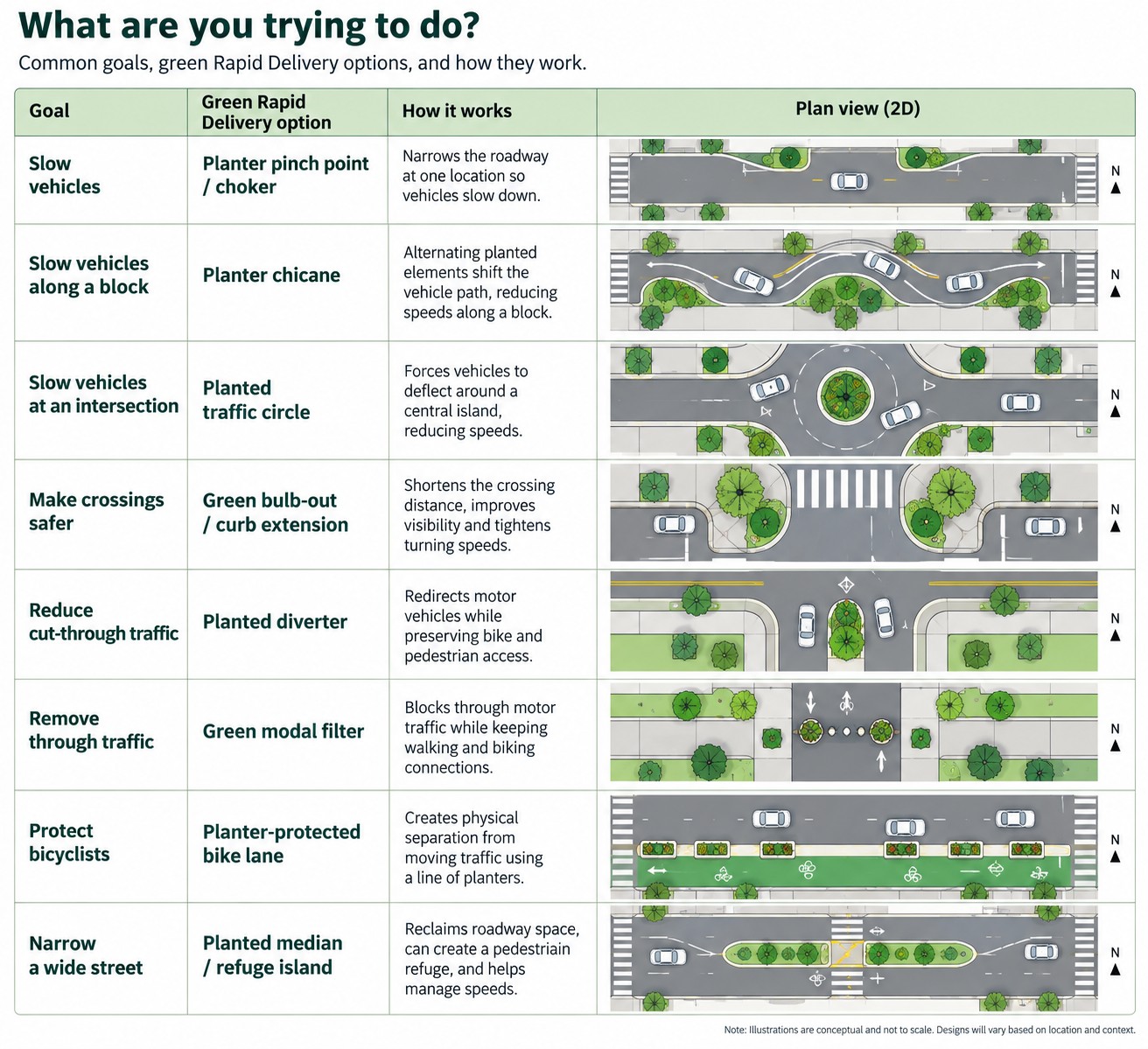
These diagrams show green Rapid Delivery options, not final engineering designs. The same street geometry can often be created with different materials and at different levels of investment.
What does it cost?
Rapid Delivery is not a choice between inexpensive plastic and expensive permanent construction. There is a spectrum of options — from paint and flexible posts to precast concrete, planted modules, movable trees, and permanent green infrastructure.
Plastic / flexible Precast / modular Planted modular Trees / GSI Permanent green infrastructure
We’re developing a sourced cost comparison using California public-agency procurement data and Caltrans bid data, alongside FHWA’s published traffic-calming costs for context. That comparison — and individual treatment examples — will be added in a future update to this page.